
Event Theme Reveal Ideas for 2026: 25+ Ways to Unveil Your Theme
By Saurabh Garg. I have run over 100 events across more than 40 countries. The theme gets the credit, but the reveal is what people remember: the moment the lights drop and a room finds out what the year is about. This guide is how I reveal a theme, and 25 plus ways to do it.
Here is the short answer, for the person who searched “theme reveal ideas” and wants something to use today. A theme reveal is the moment you unveil your event’s theme, and it works when it is built as a sequence, not a slide: a tease that plants curiosity, a build that keeps it alive, and a reveal that lands loud and gets filmed. The best formats are a live stage drop, a teaser campaign, a mystery clue drop, a sealed envelope, a gamified reveal, and a countdown film. This guide gives you all of them, plus a five-phase framework so the reveal actually builds hype instead of leaking it.
- What a theme reveal is
- Why a flat reveal costs you
- The C4E Reveal Arc: five phases of a reveal that lands
- How to plan a theme reveal, step by step
- A worked example: revealing a sales kickoff theme
- A second example: revealing an incentive trip destination
- 25+ theme reveal ideas, by format
- How to write a tease that intrigues
- Reveal formats at a glance
- When to reveal: timing by event type
- How to build a teaser campaign that does not fizzle
- Where to run the tease: choosing your channel
- Reveals for different events
- Keep the reveal on-brand
- The 2026 trends shaping theme reveals
- The echo: keeping the theme alive after the reveal
- How to measure if the reveal worked
- Mistakes companies make with theme reveals
- India-specific notes for theme reveals
- How to run a strong reveal on a small budget
- Frequently asked questions
What a theme reveal is
A theme reveal is how you announce the theme of an event to the people who will live it: your sales team, your dealers, your top performers. It is the launch moment that turns a line on a slide into a story a room feels.
Most companies write a strong theme and then waste it. They put it on a banner and read it out. No build, no surprise, no moment. The theme lands with a shrug. A reveal is the difference between “the theme this year is Summit” and a room that gasps when the mountain fills the screen.
The reveal matters because anticipation is free motivation. A theme revealed well starts working weeks before the event and keeps working after. A theme announced flat works for the ten seconds it takes to read. Same theme, opposite return, decided by how you unveil it.
This applies to every kind of event. A dealer meet theme, a sales kickoff, an annual conference, or the destination of an incentive trip. The theme changes. The craft of the reveal does not.
Why a flat reveal costs you
Skip the reveal and here is what you lose.
You lose the pre-event window. A tease that starts two to three weeks out gives you weeks of buzz before anyone walks in. Announce cold on the day and that window is gone for good.
You lose the room’s energy. The first three minutes of an event set the tone for the rest. A reveal that lands makes the room lean in. A flat opener makes them check their phones.
You lose the content. A filmed reveal, a countdown series, a clue campaign: these are shareable long after the event. A read-out theme leaves nothing to post.
You lose the recall. People remember moments, not slides. The reveal is the moment. Build it well and the theme sticks for a year. Skip it and the theme fades by the weekend.
The C4E Reveal Arc: five phases of a reveal that lands
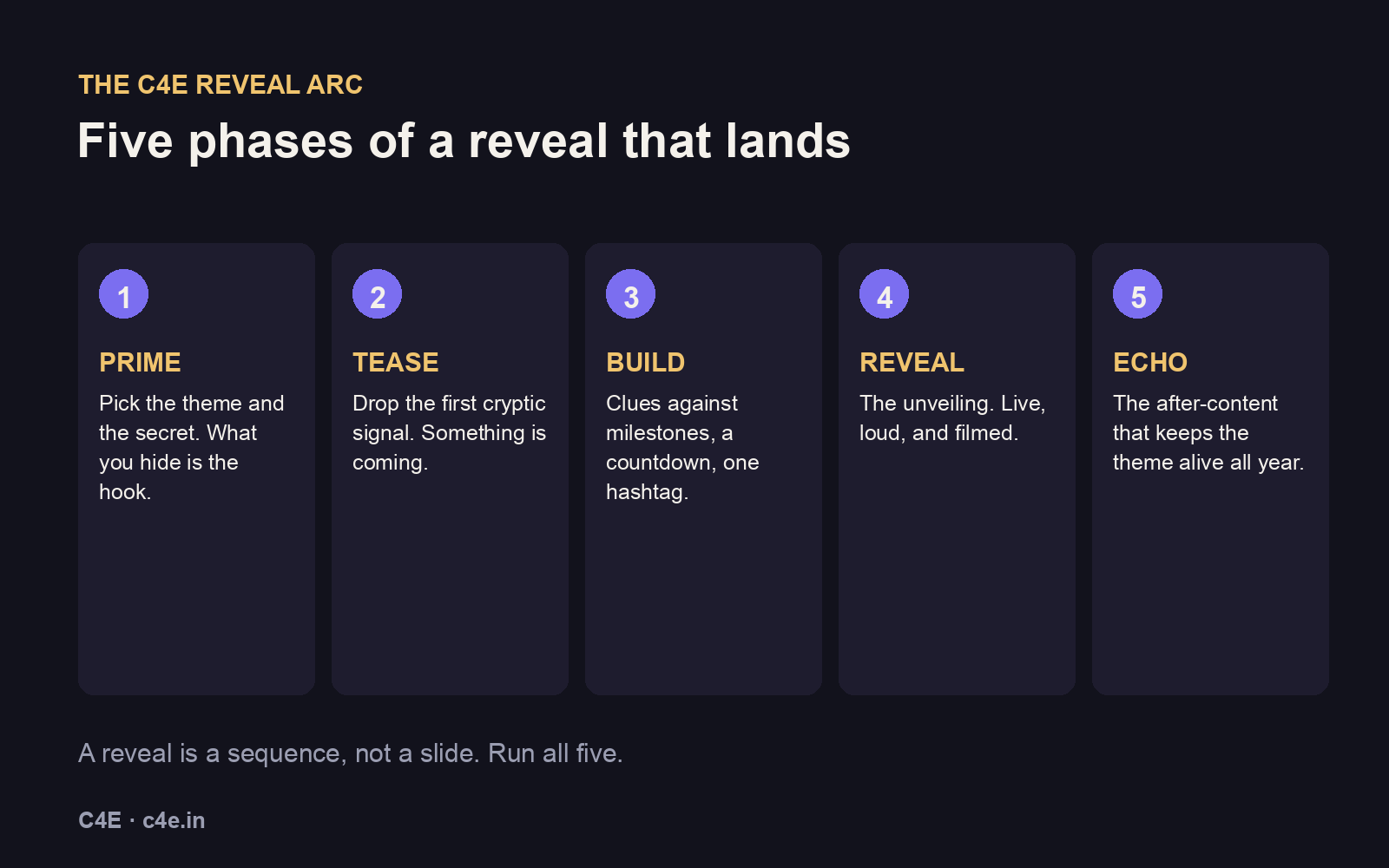
A reveal is a sequence, not a single moment. After a few hundred events I run every reveal through five phases. I call it the C4E Reveal Arc. Skip a phase and the reveal leaks its own energy.
1. Prime
Decide the theme and, more important, decide the secret. What you hide is the hook. A reveal with nothing hidden has nothing to reveal. Before you tell anyone anything, know exactly what the payoff moment is and hold it back.
2. Tease
Drop the first signal two to three weeks out. Vague on purpose. A cryptic line, a shape in shadow, a date. “Something is coming.” The tease plants a question in people’s heads and lets them carry it. Curiosity does your marketing for you.
3. Build
Keep the question alive. Drop clues against milestones. Run a countdown. Give it one hashtag. Each beat raises the temperature so the room arrives already warm. The build is where most reveals die, because people tease once and then fall silent. Do not fall silent.
4. Reveal
The unveiling. Live, loud, and filmed. Give it a real moment: a countdown, a curtain, a film, a drop. Everyone finds out together, in the room, at the same second. Capture the reaction, because the reaction is the content that sells next year.
5. Echo
The reveal is not the end. Cut the moment into content and keep the theme alive across the event and the year that follows. The after-film, the winners’ posts, the recap. A reveal you do not echo motivates only the people who were in the room.
Run all five and a reveal builds like a story. Skip one and it flattens.
How to plan a theme reveal, step by step
Here is the method I use with clients. A morning, not a month.
- Name the payoff moment. Decide the exact second of the reveal and what people see and feel. Everything works backward from that.
- Pick the format. Choose from the shelves below by your moment: a live stage room, a remote team, a long build, a fast surprise.
- Set the timeline. Work back from the event: reveal day, build beats, first tease. Two to three weeks of tease is the floor for a real build.
- Write the tease. The first signal has to intrigue without explaining. If it gives the theme away, it is not a tease, it is the reveal early.
- Lock the hashtag and the visual. One handle, one look, carried across every beat. Consistency is what makes a campaign feel like a campaign.
- Plan the capture. Decide who films the reveal and what you do with it that night. The reveal is a content shoot, not just a moment.
Do this and the reveal runs like a countdown that everyone is watching, not a surprise only you knew was coming.
A worked example: revealing a sales kickoff theme
Theory is cheap. Here is the arc in motion. Take a 200-person SaaS sales org running a January kickoff. The theme is Summit: a year about reaching the top of the market. Leadership wants the team to walk in fired up, not warmed up over coffee.
Prime. The secret is the theme word and the reveal film. Nobody outside the core team knows either. That is the payoff to protect.
Tease, week one. An internal email and a channel post: a dark image of a mountain in shadow, one line, “The climb starts January 14.” No theme word, no logo. Just the question.
Build, week two. A countdown in the sales channel. Each day, one more clue: an altitude number, a boot print, a rope. A hashtag, #TheClimb, on every post. People start guessing in the thread. The guessing is the point.
Reveal, day one. The kickoff opens in a blackout. A ninety-second film climbs a mountain and lands on one word as the summit fills the screen: Summit. The room, primed by two weeks of teasing, erupts. Cameras out. That reaction is filmed from three angles.
Echo, the year. The reveal film ships to the whole company that afternoon. Summit becomes the language of every review, every award, every deck. The theme does not fade in February, because the reveal gave it a story to live in.
One theme. Five phases. A room that arrived curious and left committed. That is the arc.
A second example: revealing an incentive trip destination
The arc works for a hidden destination too. Take a company running a President’s Club with a secret location, revealed across the year. Here is the same five phases, tuned for a trip.
Prime. Leadership picks the destination and locks it. The whole program rests on nobody else knowing. The secret is the entire engine.
Tease. At the January launch, the program is announced with the bar to qualify and one fact: the destination is hidden. “Earn your seat. We will show you where when you are close.”
Build. Every quarter the team hits a milestone, a clue drops: a currency, a climate, a dish, a flag in shadow. A guessing thread runs all year. The clues turn the target into a game people want to play.
Reveal. At the mid-year town hall, the qualifiers get a sealed envelope, opened together on a count. The place is named. The reaction is filmed and shared to the whole company, so the people who did not qualify feel what they missed.
Echo. The reveal film becomes the recruitment poster for the second half. The destination, now known, is everywhere: the countdown to departure, the packing list, the anticipation. The trip is months away and already working.
Same arc. A reward that pulls the team for a full year, not just the four days on the ground.
25+ theme reveal ideas, by format
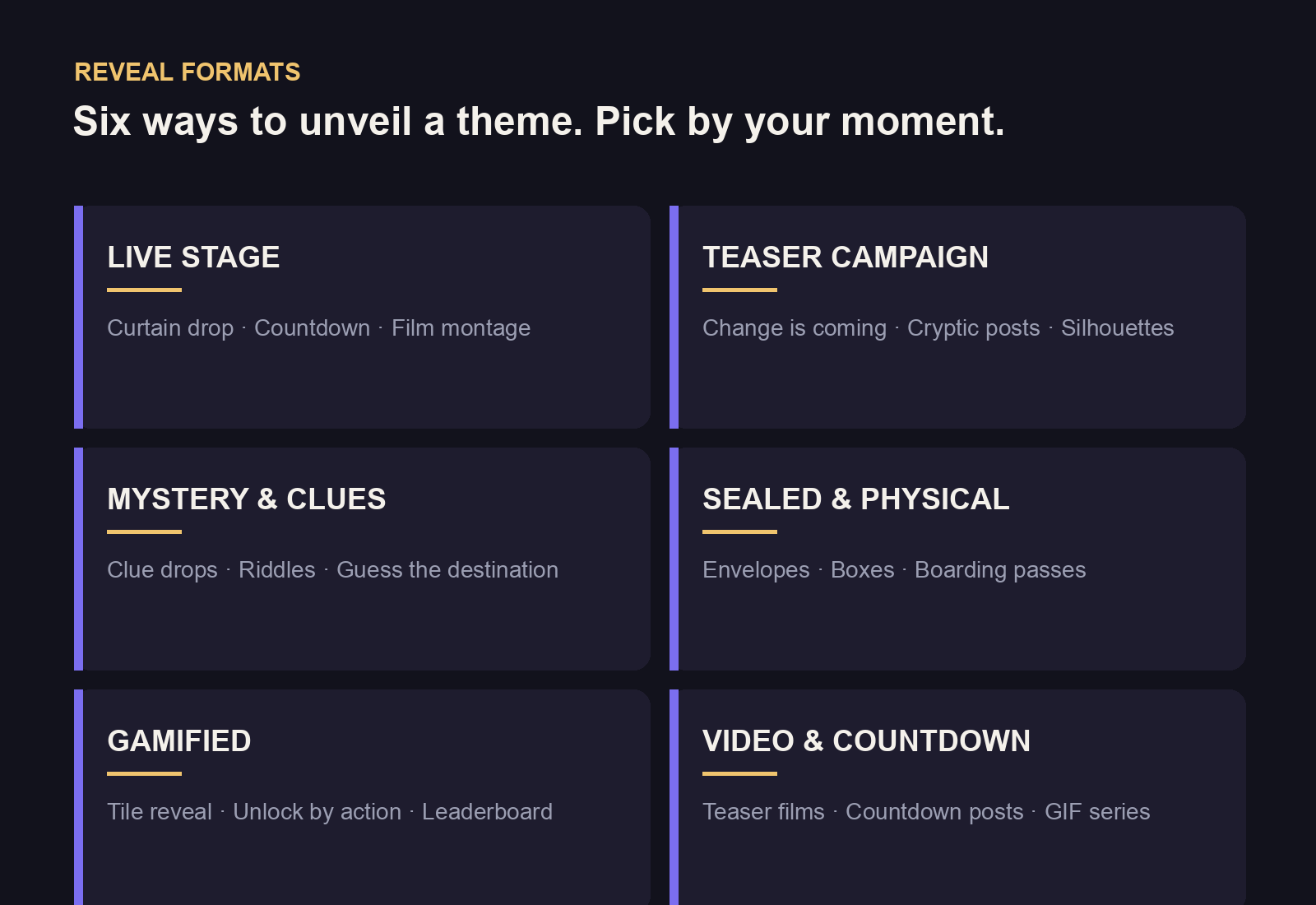
Find your moment. Pick the format that fits it.
Live stage reveals
Use these when you have the room together. The reveal happens in front of everyone, at once. The strongest format when you can get people in one place.
- The curtain drop. A physical or LED curtain falls to show the theme wall. Old, and it still works.
- The countdown open. The event opens on a countdown clock. At zero, the theme hits, loud.
- The film montage. A two-minute film builds to the theme in the last frame. Music does the lifting.
- The founder walk-on. The founder tells a short story that lands on the theme as the payoff line.
- The light and sound drop. Blackout, a beat, then the room explodes into the theme. Simple, physical, effective.
Teaser campaigns
Use these to build hype before the event, over days or weeks. Best when you have a lead time and a channel to reach people.
- “Something is coming.” A cryptic line and a date, nothing else. Let the silence work.
- The silhouette. Show a shape or a shadow of the theme. People fill the gap themselves.
- The drip. Reveal one more detail every few days: a colour, a word, a sound.
- The internal email tease. A subject line that intrigues and a body that says almost nothing. Curiosity in the inbox.
Mystery and clue drops
Use these to turn the reveal into a game people play for weeks. Best for engaged teams and destination reveals.
- Guess the destination. For an incentive trip, drop clues and let people guess. The guessing is the engagement.
- The riddle series. Each clue is a riddle that points at the theme. Solvers feel clever, and clever people share.
- The scavenger reveal. Clues hidden across the office or the app, assembled to reveal the theme.
- The leaderboard tie-in. Clues drop only when the team hits a target. The reveal rewards performance.
Sealed and physical reveals
Use these when you want a tangible, personal moment. Strong for winners, top performers, and small senior groups.
- The sealed envelope. Handed out, opened together on a count. High drama, low cost.
- The reveal box. A box that opens to the theme, or the destination inside. Unboxing is content.
- The boarding pass. For a trip, the invite arrives as a boarding pass. The theme starts before anyone books.
- The gift that hints. A themed object lands on desks with no explanation. The object is the tease.
Gamified reveals
Use these when you want people to earn the reveal through action. Best for remote teams and long build periods.
- The tile reveal. An image hidden behind tiles. Each team action removes a tile until the theme shows.
- Earn the reveal. The theme opens when the team hits a shared goal: posts, sign-ups, referrals.
- The progress bar. A public bar that fills as milestones are hit. The theme reveals at 100 percent.
Video and countdown reveals
Use these for remote or hybrid teams, where the reveal has to travel through a screen. Best when you cannot get everyone in a room.
- The teaser film. A short, cinematic build that ends on the theme. Made to be shared.
- The countdown series. Daily posts counting down, each one a fresh hint.
- The synchronized drop. The reveal film goes live to everyone at one time. A shared moment across locations.
- The GIF drip. A looping clip that shows a little more each day.
How to write a tease that intrigues
The tease is one or two lines, and it decides whether the build catches. Most teases fail because they explain. Here is how to write one that pulls.
Ask, do not tell. A tease should raise a question, not answer one. “The climb starts January 14” beats “Our kickoff theme is Summit.” One makes people wonder. The other makes them shrug.
Cut every word you can. A tease is strongest when it sits in one glance. If a line needs a second sentence to make sense, it is doing too much.
Add a date, hold the rest. A date gives people something certain to wait for while everything else stays hidden. Certainty about when, mystery about what.
Use an image that hides more than it shows. A shape in shadow, a detail with no context. The picture should deepen the question, not answer it.
Read it to one person. If they ask “what is it?”, the tease worked. If they say “so what?”, rewrite it.
Reveal formats at a glance
The format, when it fits, and how to run it. Steal this table.
| Format | Best for | How to run it |
|---|---|---|
| Live stage drop | Everyone in one room | Countdown or curtain, theme hits at zero, film the reaction |
| Teaser campaign | Lead time and a channel | Cryptic first signal 2 to 3 weeks out, then a drip of detail |
| Mystery and clues | Engaged teams, destinations | Clue drops against milestones, let people guess in public |
| Sealed and physical | Winners, small senior groups | Envelopes or boxes opened together on a count |
| Gamified reveal | Remote teams, long build | Tile reveal or progress bar that clears on team action |
| Video and countdown | Remote or hybrid teams | Teaser film plus daily countdown, synced drop to all |
When to reveal: timing by event type
The reveal timeline changes with the event. Here is the rule of thumb.
| Event | Start teasing | Reveal moment |
|---|---|---|
| Sales kickoff | 2 to 3 weeks before | Opening session, live drop |
| Dealer meet | 2 to 4 weeks before | Stage open on day one |
| Annual conference | 4 to 8 weeks before | Opening keynote |
| Incentive trip | At program launch, months out | Clue-led reveal, or on arrival |
| Product or brand launch | 3 to 6 weeks before | Live or synchronized film drop |
How to build a teaser campaign that does not fizzle
The teaser is where most reveals fail. People post once, feel clever, and fall silent for two weeks. Here is how to run a build that holds.
Start vague, get specific. The first beat says almost nothing. Each following beat adds one detail. The curve from mystery to clarity is what keeps people watching.
Give it a cadence. Decide the beats up front: day one, day three, day five, reveal. A campaign with a rhythm feels intentional. A campaign that posts when someone remembers feels dead.
Make people act. Ask for a guess, a reply, a share. A tease people respond to spreads. A tease people scroll past is a poster nobody reads.
Hold the payoff. Every beat should raise the question, never answer it. The answer belongs to the reveal, and only the reveal.
Keep one channel central. Pick where the build lives, the sales channel, the WhatsApp group, the inbox, and run it there so nobody misses a beat.
Where to run the tease: choosing your channel
A build only works where your people already look. Pick the channel by the audience.
Internal chat. Slack or Teams for an in-house team. Fast, native, and a guessing thread forms on its own. The default for most sales kickoffs.
WhatsApp. For dealers, distributors, and field sales in India, the WhatsApp group is where attention lives. Design the clue drops for the phone.
Email. For a formal or senior audience, a short teaser email with an intriguing subject line carries weight a chat message does not.
The event app. For a large conference, seed clues and countdowns in the app so the build and the event share one home.
Physical. A card on a desk, a poster in the office, an object with no note. Physical teasers cut through a full inbox.
Pick one channel to lead so nobody misses a beat, and repeat the key moments across the others.
Reveals for different events
The format shifts with the room. Here is how I match reveal to event.
Sales kickoff. The team is together and hungry for direction. A live stage drop in the opening session sets the year. Tease it in the two weeks before so people arrive curious.
Dealer meet. Independent partners, not employees. Open day one with the theme on stage, and tie the reveal to the reward or scheme you are announcing. See the dealer meet themes guide for the themes worth revealing.
Incentive trip. The destination is the reveal. A mystery clue drop across the qualification period keeps the whole team chasing. The incentive trip themes guide covers the mystery-destination play in full.
Annual conference. A bigger, mixed audience and a longer runway. A teaser campaign over weeks, landing on a keynote reveal, fits the scale.
Remote and hybrid teams. No shared room, so the reveal has to travel. A synchronized film drop plus a countdown series gives a distributed team one shared moment.
Keep the reveal on-brand
A reveal that wins the moment but breaks the brand is a bad trade. The spectacle has to sound like you.
Match the register. A playful brand can go big and loud. A premium brand reveals with restraint. The style of the reveal has to fit the company doing it, or it reads as borrowed.
Let the theme lead, not the trick. The gadget, the drone, the pyro are tools. If people remember the effect and not the theme, the reveal served itself, not the message.
Carry the brand’s look. The tease, the film, the stage should share the company’s colours, type, and voice, so the reveal feels like the brand, not a rented show.
The best reveals feel inevitable in hindsight: exactly what that company, with that theme, would do.
The 2026 trends shaping theme reveals
Reveals are moving. Here is what is changing, and how it shifts what lands.
Video-first. The teaser film is now the centre of most reveals, not an add-on. A short, cinematic build carries a theme better than any speech, and it travels to people who were not in the room.
Gamified builds. Reveals that make people earn the moment, a tile that clears on team action, a bar that fills on milestones, turn a passive announcement into a played game. Engagement rises because people have a job.
Synchronized hybrid drops. With teams split across offices and homes, the synced reveal, where everyone sees the film at the same second, recreates the shared gasp a single room used to own.
Personalized reveals. The best programs tailor the tease to the person: a clue tied to their region, a boarding pass with their name. Personal beats generic, and personal gets posted.
Leader-led storytelling. A founder telling a real story that lands on the theme beats a slick but empty animation. People trust a human on a stage more than a logo sting.
Content designed in. Reveals are built to be filmed and shared from the first frame. The reveal is a content shoot with an audience, not a moment you happen to record.
The echo: keeping the theme alive after the reveal
The reveal is one moment. The theme has to live for a year. Here is how to carry it.
- Cut the reveal film the same night. The reaction is your best content. Ship it while the energy is fresh.
- Carry the visual everywhere. The theme’s look on every deck, email, badge, and screen from the reveal onward. Repetition is what makes it stick.
- Feed the hashtag. Keep posting under the one handle so the theme stays searchable and social.
- Tie rewards to the theme. Awards, milestones, and shout-outs in the theme’s language keep it working past the launch.
- Reference it in every meeting. A theme that leaders repeat is a theme that lasts. A theme said once at a reveal is a theme forgotten.
How to measure if the reveal worked
A reveal is easy to feel and easy to fake. Measure it instead of guessing.
Pre-event engagement. Track replies, guesses, and shares during the tease. A build that got people talking before the event did its job. Silence during the tease is the first warning.
The room’s reaction. At a live reveal, the gasp, the phones, the noise are the signal. Film it, and you have both the measure and the content.
Post-event content. Count the posts, the film views, the hashtag uses after. A reveal that produced content reached past the room.
Recall. Two weeks later, can people name the theme and describe the reveal? If they can, it stuck. If they fumble, the moment was weaker than you thought.
Log these against the reveal format every year. Over time you learn which formats move your people and which spent budget.
Mistakes companies make with theme reveals
- No build, just a reveal. A surprise with no tease has no anticipation behind it. Build first.
- Teasing once, then silence. One cryptic post and nothing for two weeks kills the momentum. Keep the beats coming.
- Giving it away in the tease. If the tease explains the theme, there is nothing left to reveal. Hold the payoff.
- Not filming the reveal. The reaction is the content. Miss it and the moment lives only in the room.
- A reveal that outshines the theme. Spectacle with a weak theme underneath falls flat by lunch. The theme has to earn the drama.
- No echo. A reveal with no follow-through motivates for a day. Plan the year, not just the moment.
India-specific notes for theme reveals
Most of my reveals run for Indian companies, so here is the ground truth for this market.
The evening reveal photographs best. Split the day. Business in daylight, the big themed reveal at the night event, where the lighting, the stage, and the energy make the moment worth posting.
Vernacular lands the tease. A cryptic line in Hindi or a regional language often carries more warmth in Tier 2 and Tier 3 rooms than a polished English one. Tease in the language people dream in.
WhatsApp is the build channel. The dealer or sales group on WhatsApp is where clue drops and countdowns do their work in India. Design the build for the phone, not the inbox.
Budget the moment, not the whole night. You do not need a lavish set for a strong reveal. One well-lit, well-timed moment beats an expensive stage with no payoff.
How to run a strong reveal on a small budget
A reveal does not need a big set. It needs timing and one clear moment. Here is the lean version.
Spend on the tease, not the stage. A two-week build costs almost nothing and does most of the work. Anticipation is free.
One moment, done well. A blackout, a beat, and the theme on screen beats an expensive set with no payoff. Pick one moment and land it.
Film on a phone. A clean phone film, cut well, outperforms an over-produced video with nothing to say. The idea carries the clip, not the budget.
Let the audience make the content. Give people a reason to post, a hashtag, a photo moment, and the room becomes your production team.
Frequently asked questions
What is a theme reveal?
A theme reveal is the moment a company unveils the theme of an event to its audience, such as a sales kickoff, dealer meet, or incentive trip. Done well, it is built as a sequence: a tease that plants curiosity, a build that sustains it, and a reveal that lands live and gets filmed.
What are good theme reveal ideas?
Strong formats include a live stage drop with a countdown or curtain, a teaser campaign that starts vague, a mystery clue drop, a sealed envelope opened together, a gamified tile reveal, and a countdown film for remote teams. Pick the format by your moment: whether the audience is in a room or on a screen, and how much lead time you have.
How far in advance should you tease an event theme?
Start teasing two to three weeks before a sales kickoff or dealer meet, and four to eight weeks before a large conference. For an incentive trip, tease across the whole qualification period with clue drops. The tease needs enough runway to build curiosity without going stale.
How do you reveal a theme to a remote team?
Use a synchronized video drop so everyone sees the reveal at the same time, paired with a countdown series in the days before. A gamified reveal, where the theme is revealed when the team hits a shared goal, also works well for distributed teams.
How do you reveal an incentive trip destination?
Hide the destination and reveal it in stages. Drop clues as the team hits targets, let people guess in public, and unveil the place at a peak moment, at a town hall or with a sealed envelope opened together. The suspense keeps the whole team engaged through the qualification period.
What makes a theme reveal memorable?
Anticipation and a single clear moment. A memorable reveal builds curiosity before the event, lands the theme in one loud beat that everyone experiences together, and gets captured on film. If people were guessing beforehand and posting afterward, the reveal worked.
What is the difference between a theme and a theme reveal?
The theme is the idea of the event, like Summit or One Team One Dream. The theme reveal is how you unveil that idea to build hype. A strong theme with a flat reveal underperforms. The reveal is what turns the theme into a moment people feel.
Can you reveal a theme without a big event?
Yes. A reveal does not need a stage. A synchronized film drop, a sealed box on every desk, or a clue campaign that ends in an all-hands can unveil a theme with no formal event at all. The craft is the sequence, not the venue.
What is a mystery reveal?
A mystery reveal hides the theme or destination and unveils it in stages through clues and a countdown, so the audience solves and anticipates rather than being told. It keeps people engaged across days or months and turns the announcement into a game.
What is the best way to reveal a theme at a live event?
Open the event on the reveal. A blackout, a countdown, or a short film that builds to the theme in its final frame, so the whole room finds out together in one loud moment. Then film the reaction. A live reveal in the opening minutes sets the energy for the entire event.
How long should a reveal moment last?
The reveal itself is short: a build of sixty to ninety seconds that lands on the theme in one beat. The power is in the payoff, not the length. What runs long is the tease before and the echo after, not the moment itself.
How do you build hype before a reveal?
Start a teaser two to three weeks out with a vague first signal, then drip one detail at a time against a set cadence. Give it a single hashtag, ask people to guess, and keep the build on one central channel. Anticipation, not spend, is what builds hype.
Do theme reveals work for small teams?
Yes. A small team makes personal reveals easy: a sealed envelope opened together, a box on each desk, a clue tied to each person. Scale down the production, not the craft. The tease, the moment, and the echo matter at any size.
What should a theme reveal cost?
It ranges from almost nothing to a full production. The tease costs little and drives most of the result. Spend where the payoff moment is, live or on film, and keep the rest lean. A well-timed reveal on a small budget beats a lavish one with no build behind it.
Who should run the theme reveal?
Marketing or events owns the craft, but leadership has to front the moment. A founder or leader delivering the reveal signals it matters. Hand the mechanics to the team that builds the film and the campaign, and put a human the room trusts on the stage.
Should the reveal or the theme get more attention?
The theme is the message and the reveal is the delivery. A strong theme with a flat reveal underperforms, and a big reveal with a weak theme falls apart by lunch. Pick a theme worth revealing, then give it a moment worth remembering. Neither carries the year alone.
Submit your theme
Have you run a theme reveal that landed? Send it to us. We are building the real-world list of reveal ideas that worked, and we credit every contribution. Drop the format, the event, and one line on why it hit.
Work with C4E on your next reveal
C4E designs event themes and the reveals that launch them: the tease, the build, the stage moment, and the film that carries it all year. If you are planning one, start a conversation. Write to us at hello@c4e.in or use the form above.
Written by Saurabh Garg, founder of C4E. Over 100 events across more than 40 countries, and counting.