
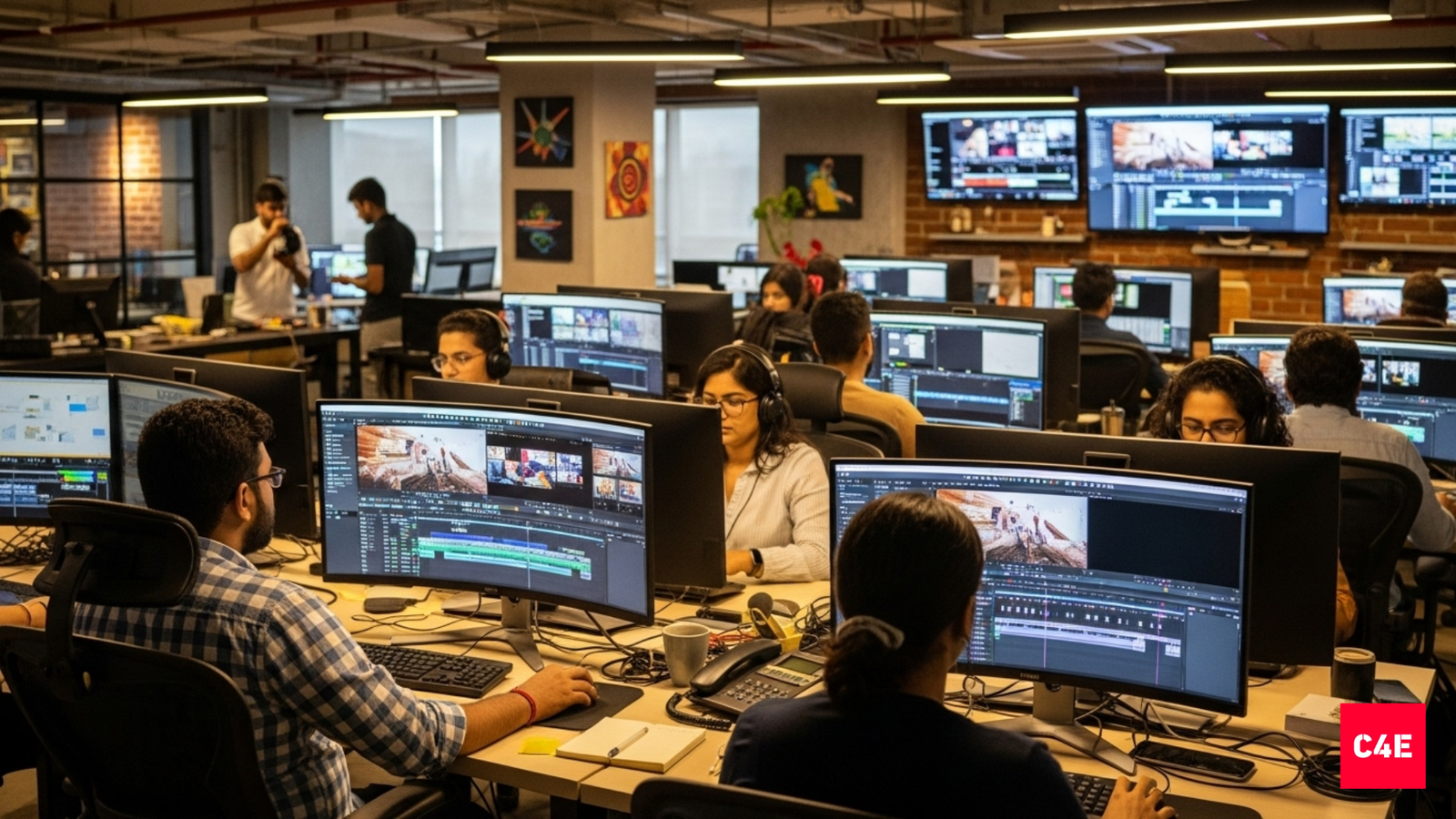
Scaling Video Editing for High-Volume Content Creators
If there’s one thing that defines the creator economy today, it’s volume.
From YouTubers running multiple channels to brands publishing five Reels a day, the game has shifted from one great video to consistent video velocity. But scaling editing output from 5 to 50 videos a month doesn’t just mean hiring more editors. It means rethinking your workflow, structure, and creative system.
The top agencies and creators that handle hundreds of clips monthly—like Nas Daily, Ali Abdaal’s team, or Indian YouTube agencies working with creators such as BeerBiceps or Curly Tales—don’t rely on chaos. They build assembly-line creativity, where clarity, templates, and automation replace endless revisions.
So how exactly do they do it?
1. Building the Assembly Line: Why Systems Beat Talent
Scaling video editing isn’t about hiring the best editors—it’s about creating repeatable systems that even average editors can excel in.
A scalable editing system has four layers:
| Layer | Function | Outcome |
|---|---|---|
| Input Layer | Receives raw footage, briefs, references, timestamps | Clear creative direction |
| Processing Layer | Editors follow templates, LUTs, pacing guides | Consistency in style |
| Review Layer | QC + Creative Review + Feedback loops | Reduced back-and-forth |
| Output Layer | Final renders, naming conventions, uploads | Fast delivery cycles |
When each layer runs on a shared tool stack (Google Drive + Notion + Frame.io, for example), the process feels like a factory line—but for creativity.
2. The Core Tool Stack for Scaling Editing
High-output teams swear by structured tools, not just skilled people.
Here’s a standard tool setup that keeps 50+ video projects flowing each month:
- Project Management: Notion, ClickUp, or Airtable for briefs, tasks, and status tracking.
- Asset Management: Google Drive, Dropbox, or Frame.io for organized file storage.
- Editing Software: Adobe Premiere Pro (for pro teams), CapCut or Descript (for speed-driven edits).
- Collaboration: Frame.io or Loom for timestamped review comments.
- Version Control: Shared folder structure with clear naming conventions (e.g., “Client_Project_Date_V3”).
Once these systems are locked, scalability becomes a matter of discipline, not chaos.
3. The “Template Economy” of Editing
Templates are the secret weapon of speed.
Top editing teams create internal libraries for:
- Intro animations and hooks
- Lower thirds, fonts, and music beds
- Sound design presets and transitions
- End screens and CTAs
These are reused across multiple clients or creators—slightly customized but never rebuilt from scratch.
The result? 80% faster first drafts and visual consistency that strengthens brand recall.
4. Defining Editing SOPs (Standard Operating Procedures)
A scalable agency documents everything—from how to label files to how to pick background music.
Example SOP checklist for editors:
- Maintain consistent pacing (2–3 cuts per second for short-form content).
- First 3 seconds must contain a strong hook or text overlay.
- Audio normalization at -14 LUFS.
- No copyrighted assets.
- Every export named as
Client_Name_Version_Date.
SOPs ensure editors from different cities or time zones can plug into the same workflow without slowing down the pipeline.
5. Building a Review-First Culture
The most underrated part of scaling video editing is review hygiene.
A good editor needs feedback; a great system ensures that feedback is fast, clear, and centralized.
Top teams use Frame.io, Vimeo Review, or Loom-based threads for feedback loops.
Every comment gets time-coded, tagged (“color correction,” “transition,” “caption fix”), and closed once updated.
This reduces revision rounds by nearly 40%, freeing up time for new projects.
6. Hybrid Teams: Mixing Human Editors and AI Tools
AI isn’t replacing editors—it’s augmenting them.
High-volume teams now combine:
- AI-powered trimming (e.g., AutoCut, Runway, OpusClip)
- AI captioning & translation (Submagic, Descript, Kapwing)
- AI B-roll generation (Pika Labs, Sora, or stock AI tools)
- AI voiceovers (ElevenLabs, Play.ht)
By letting AI handle the repetitive grunt work—like cutting silences, syncing captions, or resizing for different platforms—human editors focus on storytelling and emotion.
This hybrid model can double throughput without doubling cost.
7. Managing Creative Fatigue and Consistency
When editing 100 videos a month, burnout is real.
To keep editors inspired, leading agencies rotate projects every 2–3 weeks and alternate between high-intensity (fast-paced shorts) and low-intensity (talking-head explainer) edits.
They also use visual direction boards—a live Notion or Miro doc showcasing color palettes, trending effects, and references.
It gives editors creative guidance without micromanagement, helping maintain consistency across dozens of edits.
8. Communication Frameworks for Remote Teams
Most scaling teams are remote or hybrid.
Here’s a simple 3-tier communication model that keeps editing pipelines on track:
| Cadence | Purpose | Tool |
|---|---|---|
| Daily Check-in (10 min) | Assign, unblock, review yesterday’s edits | Slack / Standup bot |
| Weekly Sync (30–45 min) | Deep feedback, creative direction, analytics | Zoom / Meet |
| Monthly Retrospective | Identify recurring bottlenecks | Notion doc or Loom summary |
The secret is asynchronous clarity: avoid endless Zoom calls by replacing them with Loom updates and timestamped feedback.
9. The Role of a Post-Production Manager
When scaling, you need a post-production manager—a hybrid of creative lead and operations head.
Their job:
- Track timelines and deliverables
- Manage editor bandwidth
- Bridge creative vision between clients and editors
- Maintain QC across all projects
Think of them as the conductor of the editing orchestra.
Without this role, even talented teams collapse under scale.
10. Scaling Beyond People: Building a Video Operating System
At true scale, editing isn’t a department—it’s an operating system.
Mature teams build proprietary dashboards where:
- Editors log in and pick available projects.
- Feedback loops are auto-notified.
- Clients track status live.
These “micro-agencies” inside larger production ecosystems can handle 500+ monthly edits—powered by documented systems, not heroic effort.
Practical Checklist for Scaling Video Editing
| Stage | Focus Area | Action Step |
|---|---|---|
| Setup | Workflow | Define file structure, project tracker, and SOPs. |
| Production | Templates | Create reusable presets for brand fonts, LUTs, and intros. |
| Review | Feedback Loops | Use Frame.io or Loom for timestamped comments. |
| Quality Control | Consistency | Define style guide and creative checklist. |
| Growth | Automation | Integrate AI tools for captioning, resizing, and B-roll. |
From Chaos to Creative Scale
The difference between a small editing team and a high-output content agency isn’t creativity—it’s clarity.
Clarity in systems, naming, review, and accountability.
When you build this foundation, scaling from 5 to 50 videos a month becomes mechanical—freeing your creative energy for what truly matters: making content that moves people.
Partner with Experts Who Understand Scale
If you’re a brand, creator, or agency looking to scale your video output without sacrificing quality, our team helps design these exact systems — from AI-powered workflows to creative SOPs.
Let’s build your video production engine together. Write to us at cm@c4e.in
Frequently asked questions
What does a content engine include?
Strategy, a production cadence across formats (written, video, social, podcast), distribution and repurposing, measured against your goals.
High-volume editing takes a toll. Here is how creators handle editing burnout.
Do you do content strategy or just production?
Both. We start with who you’re talking to and what will move them, then produce. You can also bring us in for production alone.
How do you keep content consistent?
A documented voice, an editorial plan and a steady cadence, so one strong idea becomes a month of assets without quality drift.
Need a content engine?
C4E plans and produces content across formats, from written and social to video and podcasts.