
Employee & Sales Incentive Trip Themes for 2026: 30+ Names and How to Choose
By Saurabh Garg. I have run over 100 events across more than 40 countries. Some of them were the trips companies gave their best people: the President’s Clubs, the top-performer getaways, the reward weekends that a sales team chases all year. This guide is how I choose a theme for one, and 30 plus names and themes you can use.
Here is the short answer, for the person who searched “incentive trip theme ideas” and wants something to use today. A good incentive trip theme does one job: it turns a paid holiday into a prize people compete for. The theme is the story, the name, and the feeling that makes a winner post the photo and makes everyone who did not qualify swear they will next year. Think President’s Club, Circle of Excellence, Summit, The Italian Job, Destination X. This guide gives you the names, sorted by what you want the reward to say, plus a five-test framework so you pick one on purpose.
- What an incentive trip theme actually is
- Incentive trip, President’s Club, or sales contest: which are you running?
- Why incentive trips still beat cash
- The C4E Incentive-Trip Theme Model: five tests a theme must pass
- How to choose your incentive trip theme, step by step
- A worked example: designing a President’s Club in one afternoon
- 30+ incentive trip themes and program names, by objective
- Incentive program names at a glance
- Incentive trip themes by destination
- Match the theme to who you are rewarding
- The 2026 trends shaping incentive travel
- Activation: the reveal, the trip, and the after
- How to run a mystery destination reveal
- How to measure if the program worked
- Mistakes companies make with incentive trips
- India-specific notes for incentive trips
- Frequently asked questions
What an incentive trip theme actually is
An incentive trip theme is the idea that ties the whole reward together: the name of the program, the story of the destination, the reveal, the awards night, and the film everyone takes home. It is what turns “we are flying the top 40 to Phuket” into “you made President’s Club.”
There are two words people search here, and they are not the same. A program name is what you call the club: President’s Club, Circle of Excellence, Winner’s Circle. It is the badge a performer earns. A trip theme is the story of the experience itself: The Italian Job, Summit, The Reveal. The best programs use both. A name to chase all year, a theme to live for the four days.
The trip is the reward. The theme is what makes the reward mean something. A trip with no theme is a nice holiday people forget by the next quarter. A trip with a theme is a story a performer tells for years, and a target the whole team pins to the wall.
Incentive trip, President’s Club, or sales contest: which are you running?
People search all three, and they overlap. Knowing the difference helps you name yours right.
An incentive trip is the reward: a group trip earned by hitting a target. It is the umbrella term for any performance-earned travel.
A President’s Club is a specific, recurring incentive program, usually for a sales team, with a named club and an annual top-performer trip. Every President’s Club is an incentive trip. Not every incentive trip is a President’s Club.
A sales contest is the shorter mechanic that can feed the trip: a month or a quarter of competition whose winners earn a seat. The contest is the sprint. The club is the season. The trip is the prize.
Name yours for what it is. If it runs all year for sales, President’s Club fits. If it rewards the whole company, Circle of Excellence fits better. If it is a one-off push, a contest name and a trip theme carry it.
Why incentive trips still beat cash
Every year a founder asks me: why not just hand out the bonus? Here is the answer, and the data backs it.
The Incentive Research Foundation has found that around 80 percent of employees rate group travel rewards as very or extremely motivating. Cash gets spent on bills and forgotten. A trip gets remembered, retold, and envied. That is the difference between a reward that disappears and a reward that recruits next year’s effort.
A trip is social. Cash is private. Nobody posts their bonus. Everybody posts the sunset in Bali with the President’s Club banner. That post is your recruitment poster for the next cycle, written by the winner, for free.
A trip is a status marker. It says you were in the top few. Money in a bank account carries no status. A seat on the plane, a name on the trophy, a table at the gala: those are visible, and visibility is what drives a sales floor.
And a trip builds loyalty in a way cash cannot. Four days with the founder, the leadership, and the best peers in the company creates bonds that outlast any pay cheque. People do not leave a company where they just made the best friends and the best memory of their year.
The C4E Incentive-Trip Theme Model: five tests a theme must pass
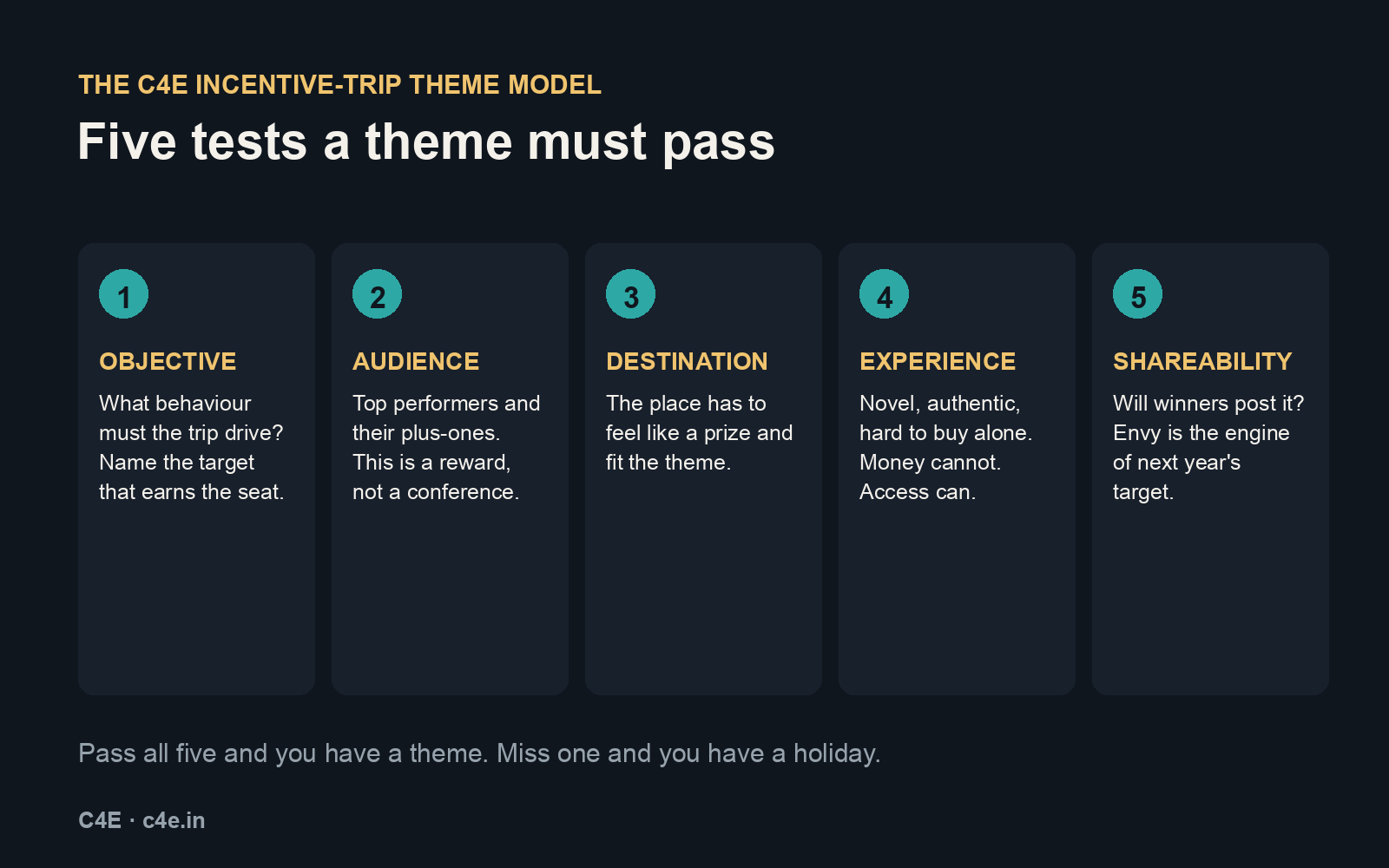
A theme that sounds nice is easy. A theme that pulls people to hit a number is a decision. After a few hundred events I run every incentive-trip theme through five tests. Pass all five and you have a theme. Miss one and you have a holiday.
1. Objective
What behaviour must the trip drive? Be specific. Are you rewarding revenue, new logos, retention, or a launch year? The theme and the qualification criteria have to point at the one number the business needs. A reward with no target attached is a gift, not an incentive. Name the target that earns the seat.
2. Audience
This is a reward, not a conference. The audience is your top performers and, often, their partners. They do not want breakout sessions and a whiteboard. They want to feel chosen. Build the theme for the person who won, and the plus-one watching them be celebrated. Get that wrong and the trip feels like work with a view.
3. Destination
The place has to feel like a prize and fit the theme. “Summit” needs mountains or a skyline that earns the word. “The Reveal” needs a destination worth hiding. A five-star resort with no story is forgettable. Match the destination to the theme and the theme to the win, so the place itself says: you earned this.
4. Experience
Money cannot buy the best incentive moments. Access can. A private dinner in a place that does not take bookings. A session with someone the winners admire. A door most tourists never walk through. The theme should promise an experience a performer could not arrange alone, at any price. That is what makes the reward feel rare.
5. Shareability
Will winners post it? Envy is the engine of next year’s target. The theme, the name, and the destination have to give people a reason to show the world they made it. If you cannot picture the photo a winner will post, and the caption they will write, the theme is not finished. Design the brag before you design the itinerary.
Run your shortlist through these five. The theme that passes all five is your answer. This is the difference between a trip people enjoy and a trip people chase.
How to choose your incentive trip theme, step by step
Here is the method I use with clients. An afternoon, not a project.
- Write the one sentence. Finish this line: “To earn this trip, a person must ______, and while they are there they should feel ______.” That sentence is your brief. The first blank is the target. The second is the reward.
- Decide the badge and the story. Pick the program name people chase all year, and the trip theme they live for four days. Name for the target. Theme for the destination.
- Shortlist five from the shelves below that fit your objective. Do not fall in love yet.
- Pressure-test each against the five tests. Cut anything that fails one.
- Check the qualification math. The theme is only as good as the target behind it. Make the bar high enough to mean something and reachable enough to chase. A club nobody can join demotivates the floor.
- Lock the name, the theme, and the reveal together. How you announce the program at the start of the year matters as much as the trip at the end. Decide all three before you brief a single vendor.
Do this and the whole program has a spine: a name to chase, a theme to picture, a target to hit.
A worked example: designing a President’s Club in one afternoon
Theory is cheap. Here is the model in motion. Take a B2B SaaS company with a 60-person sales team. Last year churn on the team ran high, the top reps felt unseen, and leadership wants to keep the best people and push net-new revenue.
Step one, the sentence. “To earn this trip a rep must hit 110 percent of annual quota, and while there they should feel like the company’s elite.” Target and reward, both named.
Step two, name and theme. The badge is the thing reps will chase and put in their LinkedIn bio, so it has to carry status. President’s Club. The trip theme is the story: a summit destination that matches the “top of the company” message. Program name: President’s Club. Trip theme: Summit.
Step three, shortlist the destination. Summit points at altitude and prestige. Switzerland, Banff, Queenstown. All say “peak” without a word.
Step four, pressure-test. Objective, yes, it rewards the revenue number that matters. Audience, yes, top reps and their partners, celebrated. Destination, yes, a summit place earns the theme. Experience, add access a rep could not buy: a private dinner at altitude, a session with the founder. Shareability, high, the photos sell themselves. Passes all five.
Step five, the qualification math. 110 percent of quota is high enough to mean something and reachable for the top 15 of 60. A club a quarter of the floor can chase, and a handful will make. Right tension.
Step six, lock the launch. Announce President’s Club: Summit at the January kickoff, with the destination teased and the bar clear. Nine months of chase from one launch.
One afternoon. A program with a name reps will fight for, a theme that fits, and a target tied to the number the business needs. That is the method.
30+ incentive trip themes and program names, by objective
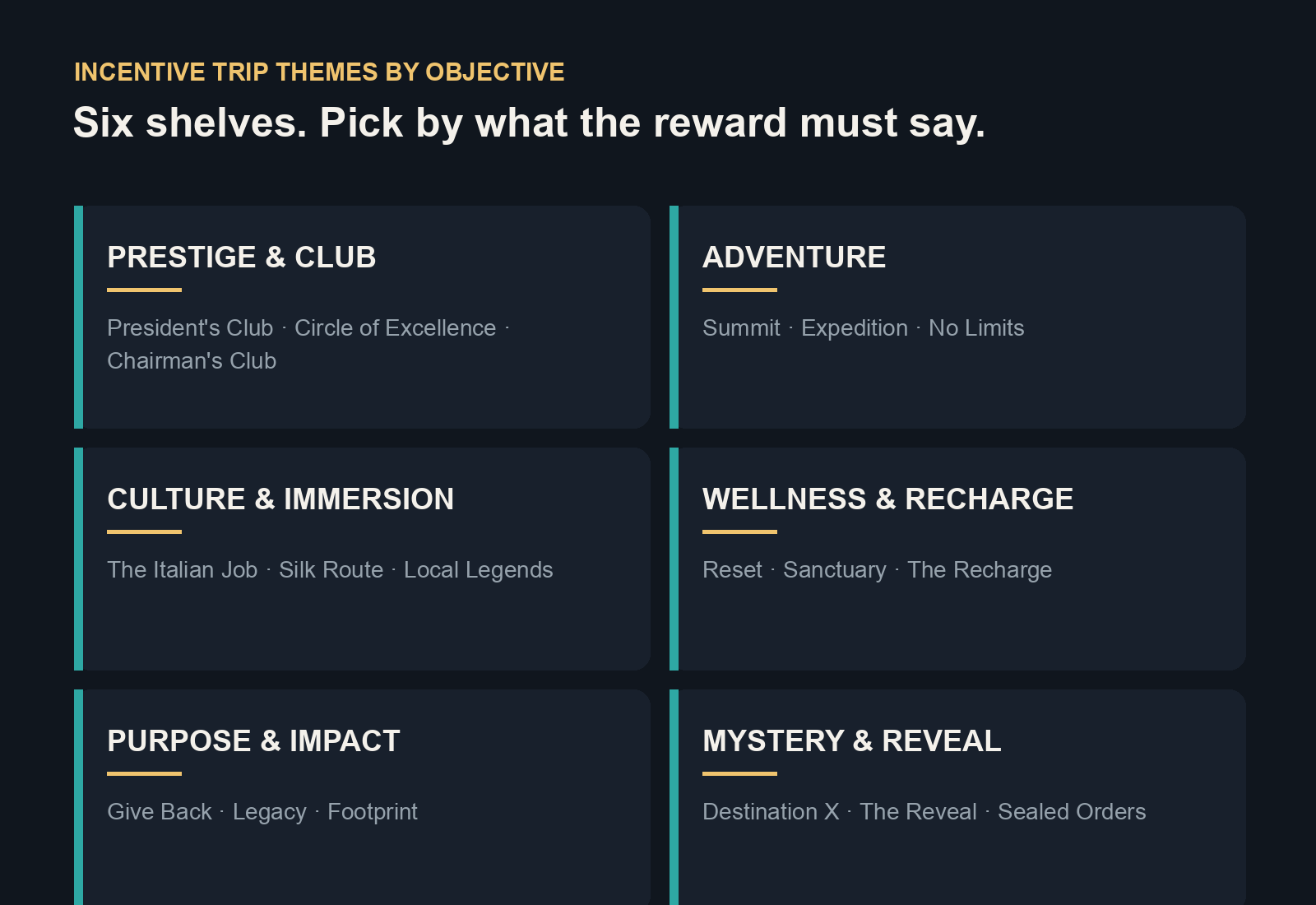
Find your objective. Pick from that shelf. Names to chase, themes to live.
Prestige and the club
Use these when the reward is about status: being in the top few, named, celebrated. The classic sales-incentive register. Fits sales floors, distribution, and any team that runs on a leaderboard.
- President’s Club. The gold standard. A seat says you were the best. Everyone on the floor knows the name.
- Circle of Excellence. Slightly softer than President’s Club, fits companies that reward more than sales.
- Chairman’s Club. For the highest tier, above the regular club. The reward for the top of the top.
- Winner’s Circle. Energetic, competitive, easy to brand with a trophy and a ring.
- Diamond Club. Tiered programs love this: Silver, Gold, Diamond. The name signals the ceiling.
- The Pinnacle. For a peak-performance year, pairs well with a mountain or skyline destination.
- Century Club. When the qualifier is a number, 100 percent of target, 100 deals, put it in the name.
Adventure and the summit
Use these when your winners are driven, competitive, and want to be pushed, not pampered. Fits younger sales teams, startups, and high-energy cultures.
- Summit. Reach the top. Works as both program name and trip theme, pairs with mountains.
- Expedition. For a trip built on adventure: safari, trek, dive, off-road.
- No Limits. High-ceiling theme for a record year.
- The Ascent. A climb metaphor for a team on the way up.
- Base Camp to Peak. A multi-tier program where each level earns a bigger reward.
- Frontrunners. For the ones out in front. Racing energy, fits a speed destination.
Culture and immersion
Use these when the reward is a rare experience, not just a beach. Fits mature teams, senior performers, and companies whose brand is taste and craft.
- The Italian Job. A named-destination theme. Rome, Tuscany, exclusive access, a story people repeat.
- Silk Route. For a trip through history and craft: markets, artisans, old cities.
- Local Legends. Built on authentic access: the chef who does not take bookings, the maker few tourists meet.
- The Grand Tour. For a multi-city reward that feels like a once-in-a-life trip.
- Table of Icons. A culinary theme: the reward is meals and makers money cannot book.
Wellness and recharge
Use these when your people are burned out and the reward is rest, not adrenaline. Fits teams after a brutal year, and cultures that value wellbeing.
- Reset. Honest and modern. The reward is space to breathe.
- Sanctuary. For a spa or wellness retreat as the prize.
- The Recharge. Direct, easy to picture, fits a beach or a restful resort.
- Still Waters. For a calm, restorative destination. The reward is peace.
- Off the Grid. For a team that never logs off. The reward is permission to disconnect.
Purpose and impact
Use these when your winners care about meaning, and you want the reward to carry the brand’s values. Fits mission-led companies and younger workforces.
- Give Back. The trip folds in a real contribution: build, plant, teach, fund.
- Legacy. For a reward that leaves something behind, in the place and in the person.
- Footprint. A sustainability-led theme for a low-impact, high-meaning trip.
- Roots. For a homecoming or heritage destination that ties to the company’s story.
Mystery and the reveal
Use these when you want the program to grip people all year. The destination is hidden and revealed in stages. Fits high-engagement sales cultures.
- Destination X. Nobody knows where. Clues drop as targets are hit. The reveal is the reward before the reward.
- The Reveal. The whole program is built around the unveiling of the place.
- Sealed Orders. Winners get a sealed envelope, opened only at the airport. High drama, high engagement.
- The Golden Ticket. A scarcity theme. Few tickets, everyone wants one.
Uncommon and modern program names
If the classics feel worn, here are fresher names that still carry status. Modern, not strange.
- The 100 Club. For quota-based qualification. The number is the badge.
- Orbit. Top-tier, aspirational, fits a tech or young brand.
- Vanguard. For the ones leading from the front.
- The Founders’ Table. Access to leadership is the reward. Intimate and rare.
- Apex. Peak performance in one word.
- The Inner Circle. Scarcity and belonging. Few seats, high status.
- Trailblazers. For a launch year or a new-market push.
Incentive program names at a glance
The badge people chase, what it fits, and the signal it sends. Steal this table.
| Program name | Best for | The signal it sends |
|---|---|---|
| President’s Club | Sales floors, classic top-performer reward | You were the best. Everyone knows the name. |
| Circle of Excellence | Cross-functional reward beyond sales | You set the standard for the company. |
| Chairman’s Club | The top tier above the main club | You are the best of the best. |
| Winner’s Circle | Competitive, energetic cultures | You won. Stand in the circle. |
| Diamond Club | Tiered programs (Silver, Gold, Diamond) | You reached the ceiling. |
| Summit | Driven, younger, high-energy teams | You reached the top. |
| Century Club | Number-based qualifiers | You hit the number that matters. |
Incentive trip themes by destination
The destination and the theme have to agree. Here is how to match them.
| Destination | The vibe | Themes that fit |
|---|---|---|
| Bali / Phuket / Maldives | Reward, rest, status beach | The Recharge, Sanctuary, President’s Club |
| Switzerland / Alps | Peak, prestige, altitude | Summit, The Pinnacle, The Ascent |
| Italy / France | Taste, craft, culture | The Italian Job, Table of Icons, The Grand Tour |
| Dubai / Singapore | Modern, aspirational, fast | No Limits, Frontrunners, Circle of Excellence |
| Africa / Costa Rica | Adventure, wildlife, awe | Expedition, Off the Grid, Footprint |
| Undisclosed | Suspense, engagement | Destination X, Sealed Orders, The Reveal |
Match the theme to who you are rewarding
The same trip reads differently depending on who earns it. Match the theme to the audience.
Sales teams. Competitive, leaderboard-driven, status-hungry. Prestige and club names win: President’s Club, Winner’s Circle, Summit. The badge matters as much as the beach.
Channel partners and dealers. Independent business owners, not employees. The reward has to respect their standing and often welcome family. Circle of Excellence, The Grand Tour, and destination-led themes fit better than internal-sounding club names.
Whole-company programs. When you reward across functions, not just sales, avoid sales-only language. Circle of Excellence, Legacy, and Give Back include the whole company in the story.
Top leadership and MVPs. For a small, senior group, intimacy beats scale. The Founders’ Table, The Inner Circle, and rare-access themes land harder than a big group gala.
Younger, mission-led teams. Purpose and experience move them more than luxury. Give Back, Footprint, and Expedition fit a workforce that values meaning and adventure over thread count.
Name the audience first. The theme that fits a sales floor feels wrong to a channel partner, and the theme that flatters a partner feels soft to a rep. Design for the person who earns the seat.
The 2026 trends shaping incentive travel
Incentive travel is moving. Here is what is changing, and how it shifts the themes that land.
Experience over luxury. Winners have seen the five-star resort. What moves them now is access: the closed door, the private table, the person they admire in the room. Themes built on rare experience beat themes built on thread count.
Purpose is entering the reward. More programs fold a real contribution into the trip: a build, a planting, a day with a local community. Themes like Give Back and Legacy carry meaning alongside the reward, which younger winners value.
The mystery reveal is winning. Hiding the destination and revealing it in stages keeps a program alive all year. Destination X and Sealed Orders turn a static reward into a running story.
Bleisure and choice. Winners want some control: an extra day, a choice of activity, a way to bring family. Themes and packages that build in choice beat a fixed itinerary marched through in lockstep.
Wellness as the reward. After hard years, rest is a prize. Reset and Sanctuary themes answer a team that is tired, not one that wants more adrenaline. Read the year before you pick the register.
Content-first design. The after-movie and the winners’ posts get planned before the trip, not after. The theme has to give the film a spine and the winner a photo. A reward you do not capture motivates only the people who went.
Activation: the reveal, the trip, and the after
An incentive trip is not one event. It is three: the launch, the trip, and the afterlife. Most companies nail one and waste the other two.
- The launch. This is where the theme earns its money. Announce the program at the start of the year with the name, the destination or the mystery, and the qualification bar. A strong launch is nine months of motivation for one hour of effort.
- The chase. Keep the theme alive all year. A leaderboard in the theme’s language. Clue drops for a Destination X. Monthly nudges that remind people what they are playing for. The theme should live between launch and trip, not sleep.
- The reveal. If you hid the destination, the unveiling is a marketing moment in itself. Film it. The reaction is content.
- The awards night. The trip needs one moment where winners are named in front of peers and partners. This is the status payoff. Spend on it.
- The after-movie. Cut a film of the trip and put it in front of the whole company. The people who did not go should feel the fear of missing out. That film sells next year’s target better than any email.
- The winners’ content. Give winners something worth posting: a branded moment, a photo op, a hashtag. Their posts are your recruitment for the next cycle.
The trip is four days. The theme, launched and filmed, works for twelve months.
How to run a mystery destination reveal
The hidden-destination program is the strongest engagement play in incentive travel right now, so here is how to run one without it falling flat.
Seed the mystery at launch. Announce the program, the bar, and the fact that the destination is secret. The secret is the hook. Give it a name: Destination X, Sealed Orders, The Golden Ticket.
Drop clues against milestones. Every time the team hits a checkpoint, release a clue: a climate, a flag, a dish, a skyline in shadow. The clues keep the program alive between launch and trip, and turn the target into a game.
Let people guess in public. A leaderboard and a guessing thread turn private effort into shared theatre. The guessing is free engagement, and it keeps the reward top of mind.
Reveal at the peak moment. Unveil the destination when it lands hardest: at a town hall, or with a sealed envelope opened together at the airport. Film the reaction. That reaction is your best recruitment content for next year.
Keep one surprise for the trip itself. Even after the reveal, hold back one experience. A performer who thinks they know the whole trip has nothing left to look forward to. Save a moment.
How to measure if the program worked
Most companies run the trip and never check if it moved anything. Then they argue about next year with no data. Measure these.
The target. Did the behaviour the club rewarded actually move? Revenue, retention, new logos, whatever the qualifier was. This is the point of the whole exercise.
The chase. How many people were in real contention through the year, not just the winners? A program only the top three chase is priced wrong. A healthy club pulls the whole floor.
Retention of winners. Track whether your President’s Club members stay. The trip is a loyalty tool. If winners leave anyway, the reward is not landing.
The content. Count the posts, the after-movie views, the reactions. A trip that produced envy across the company worked. A trip nobody saw motivated only the people on the plane.
Log all four against the program name and theme, every year. In three cycles you will know which themes and which bars move your team, and which spent budget.
Mistakes companies make with incentive trips
- No theme, just a destination. “We are going to Goa” is a holiday. Without a name and a story, it does not drive a target.
- A bar nobody can clear. A club only two people can join demotivates the other ninety-eight. Set the bar high and reachable.
- Turning the reward into a conference. Cram the trip with sessions and it stops being a prize. Protect the reward.
- No reveal, no after-movie. Skip the launch and the film and you waste the eleven months around the four days.
- Forgetting the plus-one. The partner who watched someone work all year is part of the reward. Design for them too.
- Same trip, every year. Repeat the exact reward and it stops being special. Evolve the theme.
India-specific notes for incentive trips
Most of my incentive programs run for Indian companies, so here is the ground truth for this market.
Domestic can out-punch international. A well-designed trip to Udaipur, Goa, or the backwaters, with the right theme and access, can beat a rushed overseas trip on a tight budget. The theme matters more than the passport stamp. Do not go abroad on a budget that makes the trip feel thin.
International tiers create the chase. A two-tier program, domestic for the qualifiers and international for the top tier, gives the floor two bars to chase. Bali for the club, Switzerland for the Chairman’s tier.
Family changes the math. Indian winners often value bringing a spouse or family over a solo luxury trip. A theme and a package that welcome family buys loyalty a fancier solo trip cannot.
Plan the calendar around the money. Factor in visa timelines for international rewards, and budget for the real cost of a themed program: the launch, the film, the gifting, not just the flights and the rooms.
Frequently asked questions
What is an incentive trip?
An incentive trip is a reward, usually an all-expenses-paid group trip, given to employees or salespeople who hit a performance target. Unlike regular business travel, its purpose is to motivate and recognise top performers. Research from the Incentive Research Foundation finds around 80 percent of employees rate group travel rewards as very or extremely motivating.
What are good incentive trip theme ideas?
Strong themes sort by what the reward should say. For status: President’s Club, Circle of Excellence, Chairman’s Club. For adventure: Summit, Expedition, No Limits. For culture: The Italian Job, Silk Route. For rest: Reset, Sanctuary. For suspense: Destination X, The Reveal. Pick by objective, not by which name sounds nicest.
What is the difference between a program name and a trip theme?
A program name is the badge a performer earns and chases all year, like President’s Club. A trip theme is the story of the experience itself, like The Italian Job or Summit. The best incentive programs use both: a name to chase, a theme to live.
What are some good President’s Club alternatives?
Common alternatives include Chairman’s Club, Circle of Excellence, Winner’s Circle, Diamond Club, CEO Circle, Summit Club, and Century Club. Choose the one that fits your culture and the signal you want the badge to send.
How do I choose an incentive trip theme?
Start from the objective. Write the sentence: to earn this trip a person must do X, and while there they should feel Y. Shortlist themes that serve that objective, then pressure-test each against five tests: objective, audience, destination, experience, and shareability. The theme that passes all five is your choice.
Why give an incentive trip instead of a cash bonus?
A trip is remembered, shared, and envied. Cash is spent and forgotten. A trip carries status, builds loyalty through shared experience, and produces content that motivates the whole team for the next cycle. That is why most companies find travel rewards out-motivate cash of the same value.
How much does an incentive trip cost per person?
It ranges wide by destination, duration, and tier, from a domestic long weekend to a multi-day international program. The real cost includes the launch, the awards night, gifting, and the after-movie, not just flights and rooms. Decide the budget band first, then choose a theme and destination that can be delivered in full inside it.
What makes an incentive trip memorable?
A clear theme, a destination that feels earned, and access money cannot buy. Memorable trips name the winner in front of peers, welcome the plus-one, and give people a moment worth posting. If a winner is still telling the story a year later, the trip worked.
What should we spend on: the trip or the reveal?
Both, in balance. Underspend on the launch and reveal and the trip motivates only for the four days it runs. Underspend on the trip and the reward feels thin when winners arrive. Split the budget so the program pulls all year and the trip pays off when they land. The after-movie is the cheapest line with the longest return.
How many people should qualify for an incentive trip?
Enough that the whole team believes they have a shot, few enough that the seat carries status. A common range is the top 10 to 20 percent of the qualifying group. Too many and the reward loses its shine. Too few and only a handful ever chase it.
What is a mystery incentive trip?
A mystery incentive trip hides the destination and reveals it in stages as the team hits targets. Programs like Destination X and Sealed Orders use clue drops and a big reveal to keep people engaged all year, not just at the trip. The suspense is part of the reward.
Do incentive trips work for non-sales teams?
Yes. Any team with a measurable goal can be rewarded with a trip: support, operations, engineering, or the whole company. Use inclusive themes like Circle of Excellence or Legacy rather than sales-only club names, and tie qualification to the goal that team owns.
What are good one-word incentive program names?
Strong one-word names include Summit, Apex, Orbit, Vanguard, Pinnacle, Elevate, and Ascend. One-word names are easy to brand on a trophy and a banner. Pair each with a clear qualification bar so the badge means something.
Can we reuse the same program name every year?
Yes for the name, no for the trip. Keep a stable badge like President’s Club so it builds equity year over year, but change the destination and the trip theme each cycle so the reward stays fresh and worth chasing again.
How far in advance should we launch an incentive program?
Launch at the start of the performance period, usually the annual or half-yearly kickoff, so people have the full run to chase it. Book the destination and design the theme two to three months before that launch. The earlier the bar is clear, the longer the program motivates.
Should partners or family be included on the incentive trip?
Often yes. The partner who supported a performer through the year is part of the reward, and for many winners bringing a spouse or family raises the value of the trip above a solo luxury version. Build the theme and package to welcome them where budget allows.
Submit your theme
Have you run an incentive trip or a President’s Club with a name or theme that worked? Send it to us. We are building the real-world list of incentive program names and trip themes, and we credit every contribution. Drop the name, the destination, and one line on why it landed.
Work with C4E on your incentive program
C4E designs incentive trips and President’s Club programs end to end: the name, the reveal, the destination, the awards night, and the film that keeps the team chasing next year’s seat. If you are planning one, start a conversation. Write to us at hello@c4e.in or use the form above.
Written by Saurabh Garg, founder of C4E. Over 100 events across more than 40 countries, and counting.