
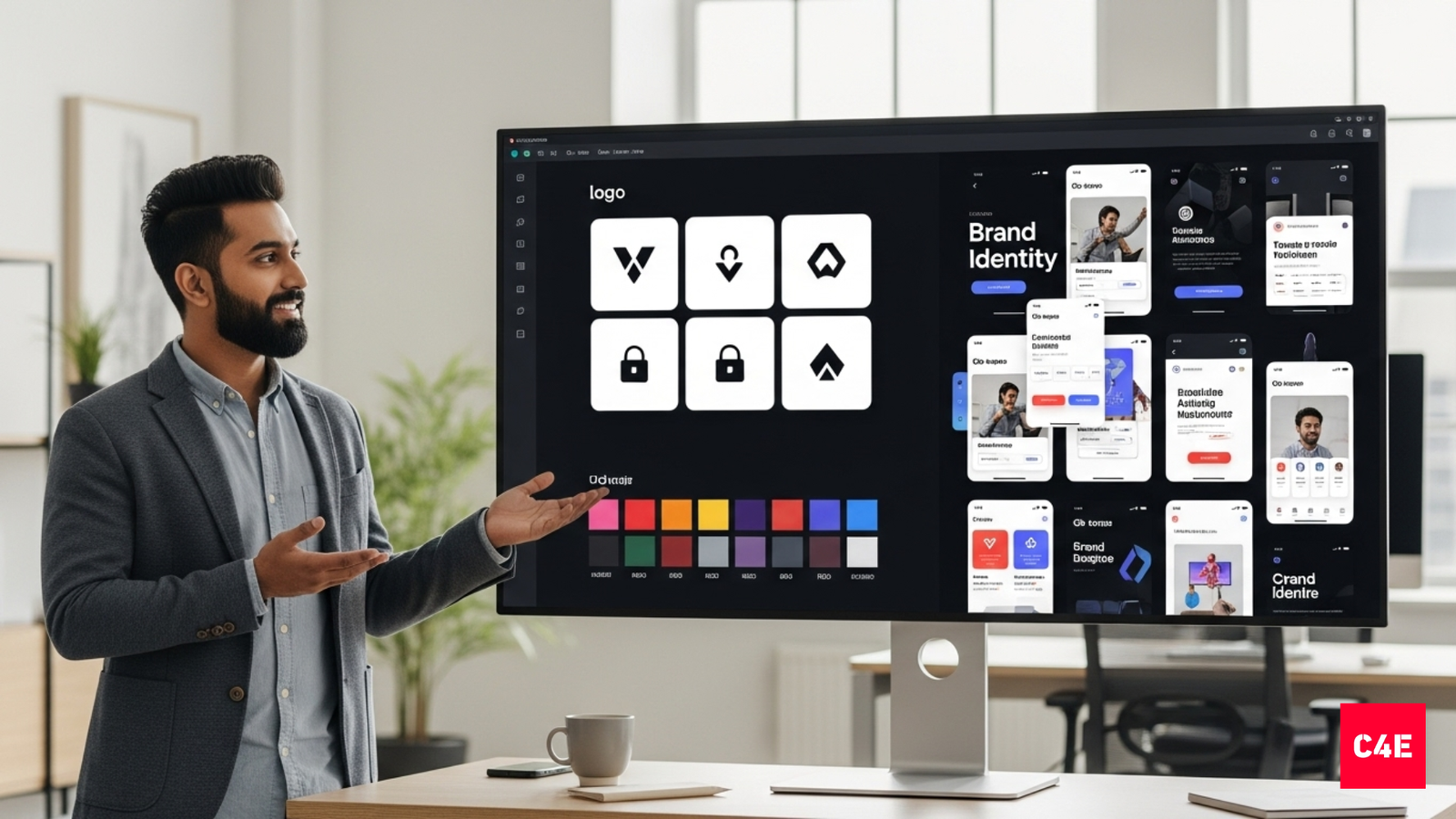
Building Brand Identity for Consumer Tech Startups in India
Consumer tech is no longer a niche — it’s how India lives, shops, and connects.
Whether it’s Zepto delivering groceries, CRED gamifying finance, or Noise selling wearables, consumer tech brands now shape culture as much as they sell convenience.
In this landscape, product-market fit alone isn’t enough.
Founders must also build brand-market fit — where your identity, story, and visual system make users feel something before they even use the app.
Because when your product can be copied in 3 months, it’s the brand that lasts.
1. What Makes a Consumer Tech Brand “Stick”
In India, where 800+ consumer tech startups compete for daily attention, the brands that stand out share three traits:
| Trait | Meaning | Example |
|---|---|---|
| Distinct Visual Recall | Instantly recognizable colors, shapes, or icons | CRED’s dark luxury aesthetic, Zepto’s purple-black delivery design |
| Emotional Anchor | A belief users can identify with | Groww’s “simple investing,” Swiggy’s “hunger delivered” |
| Adaptive System | A design and tone that evolves across new product lines | Zomato’s design consistency across delivery, dining, and Blinkit |
In short, a strong brand identity gives startups a visual and verbal backbone that scales faster than the product itself.
2. The Three Layers of Brand Identity
Every consumer tech founder should think of brand identity in three layers:
| Layer | Focus | Outcome |
|---|---|---|
| Core Brand Layer | Values, purpose, tone, positioning | Defines who you are and why you exist |
| Design System Layer | Logo, typography, colors, motion | Makes your brand visible and repeatable |
| Experience Layer | UI, packaging, social media, ads | Makes your brand feel cohesive |
Together, they create what design strategists call “perceptual consistency.”
No matter where users see you — app screen, ad, or Instagram — they feel the same brand.
3. Case Study 1: Zepto — Minimalism as Momentum
When Zepto entered India’s crowded quick-commerce market, it didn’t rely on flashy design or discount-heavy communication. Instead, it chose a distinct identity rooted in minimalism and speed.
- Color palette: Deep purple and black — unusual for delivery apps, conveying confidence and youth.
- Typography: Rounded, bold sans-serif fonts that mirror velocity and clarity.
- Tone: Crisp, confident copy — no fluff, no chaos.
- Design system: Adaptable visuals across delivery bags, app icons, and OOH hoardings.
By using speed as both a service promise and a visual motif, Zepto built one of India’s youngest billion-dollar brands without diluting its focus.
The lesson: design doesn’t just decorate your brand — it delivers your value proposition visually.
4. Case Study 2: CRED — Luxury in a Utility Category
CRED redefined how fintech brands in India look and sound.
Before CRED, financial apps were blue, functional, and rational. CRED made finance feel aspirational and cult-like.
- Design: Monochrome palettes with gold gradients and textures evoking exclusivity.
- Language: Confident, slightly absurd humor. “You earn CRED coins. You don’t need them.”
- Experience: Fluid animations and cinematic interfaces.
The CRED example proves that brand identity is not just about colors or logos — it’s about emotion.
It turned credit card management into a lifestyle signal.
Every consumer tech founder can take note: a well-crafted identity can elevate a functional app into a cultural symbol.
5. Case Study 3: Groww — Simplicity Wins Trust
Finance in India has historically been intimidating. Groww solved that with simplicity — not just in UX, but in its entire brand design.
- Logo: A calm upward-pointing leaf — subtle growth symbolism.
- Tone: Friendly, explanatory, and transparent.
- Design System: White and green dominance, lightweight visuals, consistent iconography.
By visually decluttering finance, Groww made investing feel accessible.
Their YouTube channel, app, and even helpdesk visuals follow the same design grammar — proving that clarity builds trust faster than advertising.
6. Case Study 4: Noise — Lifestyle-Led Tech Identity
Wearable brand Noise transformed from an accessory maker into a lifestyle brand by aligning its design language with self-expression.
- Logo evolution: Clean sans-serif mark reflecting modernity.
- Campaign tone: Youthful, energetic, motivational (“#DoItYourWay”).
- Product visuals: Lifestyle-heavy imagery instead of product-only photos.
The result: Noise became aspirational tech — more fashion, less gadget.
This pivot reflects a key insight for founders: brand identity should evolve with the category you want to lead, not the one you entered.
7. Designing for Indian Consumers: What Founders Miss
While global design inspiration is great, Indian startups face unique realities:
- Diverse cultural sensibilities — colors and symbols carry regional meaning.
- Lower visual literacy in Tier 2/3 markets — clarity over cleverness.
- High mobile usage — design must look great even on small screens.
So, design systems must be:
- Bold enough for recall.
- Simple enough for understanding.
- Flexible enough for growth.
An app-first brand identity isn’t a luxury — it’s a necessity.
8. The Brand Identity Framework for Consumer Tech Startups
Here’s a structured approach for founders to build identity the right way:
| Stage | Goal | Action Step |
|---|---|---|
| Brand Discovery | Define purpose, audience, positioning | Run internal workshops and user interviews |
| Strategic Narrative | Craft your core belief and tagline | Example: “Speed is happiness” (Zepto-like clarity) |
| Visual Identity | Create logo, color palette, type system | Hire brand design studio or creative partner |
| Design Systemization | Build templates for UI, social, ads | Document in Figma / Notion |
| Implementation | Roll out across app, comms, and PR | Audit consistency monthly |
| Evolution | Refresh based on user feedback | Minor tweaks every 12–18 months |
This framework helps founders avoid fragmented visuals and build an identity that scales with new product lines or funding rounds.
9. Common Mistakes Startups Make in Brand Design
| Mistake | Impact | Fix |
|---|---|---|
| Copying global visual trends | Feels disconnected from Indian context | Adapt global cues to local sentiment |
| Overcomplicating the logo | Hard to recall or use across screens | Prioritize simplicity and scalability |
| Ignoring tone of voice | Inconsistent messaging across touchpoints | Define a brand dictionary early |
| One-time branding exercise | Identity becomes outdated | Treat branding as a living system |
| No alignment with UI/UX | App feels detached from marketing | Unify marketing and product design teams |
A startup’s visual identity isn’t just what investors see on pitch decks — it’s what users internalize subconsciously every time they open your app.
10. The Scale Equation: Design Systems That Grow with You
At seed or Series A, founders often build brands on instinct. But at Series B and beyond, scale demands system thinking.
That means:
- Having Figma libraries with tokens for color, typography, icons.
- Defining brand behavior for motion and microinteractions.
- Training internal teams to maintain visual and tonal consistency.
In short, your brand identity should be a system, not an art project.
Think like Zepto, not a design contest.
11. What’s Next: Brand Identity in the AI Age
AI tools are now helping startups scale their brand systems faster:
- Midjourney / Leonardo.ai: Prototype ad visuals before shoots.
- Runway / Sora: Create motion design variations instantly.
- Frontify / Bynder: Manage brand guidelines dynamically.
This helps small teams look enterprise-ready — giving early-stage founders the same creative muscle as billion-dollar brands, at a fraction of the cost.
Final Reflection: Identity as the New Moat
In India’s consumer tech ecosystem, competition will always catch up on product, pricing, or feature parity.
The only sustainable advantage is perception — how users remember you when you’re not in front of them.
That’s what brand identity builds: a memory, a feeling, and a reason to stay loyal.
When designed thoughtfully, it turns your startup from an app people use into a brand they root for.
Build a Brand That Scales Beyond Code
We help consumer tech founders translate product clarity into brand clarity — through strategy, storytelling, and scalable design systems.
If you’re building the next Zepto or Groww, let’s craft a brand identity built to last.
Frequently asked questions
What makes a brand stand out?
A clear point of view made visible: an owned colour, distinct typography and a consistent voice, repeated everywhere until people recognise you before they read the name.
Do we need a rebrand or just a refresh?
Most companies need a refresh (evolved design, sharper messaging), not a full rebrand. Start with an audit before deciding.
How long does brand work take?
A focused brand strategy and identity project usually runs 8 to 12 weeks, depending on scope and decision speed.
Building or sharpening a brand?
C4E treats brand as a strategic business tool: positioning, identity and design that solve real problems.